REVIEW · SIEM REAP
Siem Reap: 2-Days Angkor Wat with Sunrise Small-Group Tour
Book on GetYourGuide →Operated by Tourme ANGKOR · Bookable on GetYourGuide
Angkor Wat at sunrise changes the temperature of your whole trip. I love the small-group pacing that keeps the stops feeling human, and I also love the practical touches like cool towels and bottled water between temples. The only real downside is simple: it’s a lot of walking, climbing, and early mornings, and you’ll want to be ready for stairs.
What makes this experience work is the way the monuments get explained while you’re standing right in front of them. Guides like Sak, Pal, Bun, and Chhay are known for turning carvings and layout into something you can actually picture, not just names on a sign. If you want a guided shortcut to understanding Angkor without doing all the planning yourself, this tour format fits very well.
In This Review
- Key things that make this tour worth your time
- The 2-day rhythm: early starts, strong sights, and a finish you can recover from
- Day 1: Banteay Srei and the Grand Circuit stops that change the pace
- Pre Rup Temple: a stepped pyramid with a viewpoint feeling
- Banteay Srei Temple: small size, detailed carvings
- Neak Pean: a Buddhist temple on a man-made island
- Preah Khan Temple: large, atmospheric, and easy to get caught in
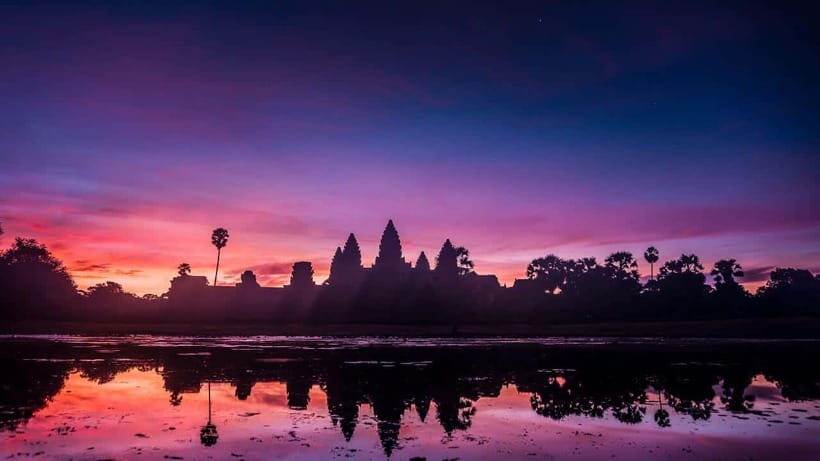
- Day 2 sunrise at Angkor Wat: the early pickup is the whole point
- Ta Prohm to Bayon: tree roots, then stone faces, then more stairs
- Ta Prohm: overgrown and photogenic in a very real way
- Eastern Gate of Angkor Thom: gods and demons along the entrance
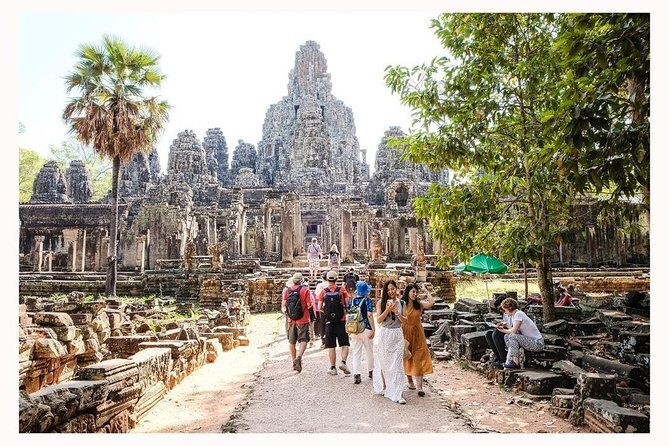
- Bayon Temple: those faces never get old
- Terrace of the Elephants and the Leper King: the quieter story beats
- Guides, drivers, and why the small-group format matters in real life
- Price and value: $16 is the bait, the temples pass is the reality
- What to bring, what to expect, and the heat-proof checklist
- Should you book this Angkor 2-days sunrise tour?
- FAQ
- Do I need a temples pass for this tour?
- What time does pickup happen on each day?
- Is the tour in English?
- What’s included in the price?
- What should I bring for the temples?
- Is sunrise guaranteed?
- Can I skip the ticket line?
- How long is the tour?
- Can I cancel for a refund?
Key things that make this tour worth your time
- Sunrise timing that favors good viewing at Angkor Wat, with very early pickup on Day 2
- A guide who connects the temple visuals to meaning, from inscriptions to Khmer-era religion
- Day 1’s temple variety: Pre Rup, Banteay Srei, Neak Pean, and Preah Khan
- Ta Prohm’s tree-wrapped atmosphere followed by the more structured Bayon and Angkor Thom sites
- Heat management you can feel, with A/C transport and cooling breaks after walks
- Free time to explore, so you’re not stuck only listening and taking notes
The 2-day rhythm: early starts, strong sights, and a finish you can recover from
This is a two-day plan built around the reality of Angkor: the temples aren’t all near each other, and daylight matters. Day 1 runs like a classic circuit day. You get picked up around 7:45am to 8:00am and you’re back to your hotel area around 4:00pm to 5:00pm. Day 2 is different, because you leave at about 4:20am to 4:35am to catch sunrise. Then you’re finished mid-day, typically around 12:30pm to 1:30pm, which is a big deal if you want the afternoon back for massage, laundry, or just sitting down.
I like this schedule because it avoids the common trap of doing sunrise plus another all-day marathon. You get the early magic, and then you’re not stuck with temples until dinner. The tour also lets you swap the two days on request, which is useful if you’re juggling other Siem Reap plans.
One small consideration: sunrise quality depends on weather. If clouds move in, the payoff can be softer. You still get the atmosphere of being there in the dark and the early light, but you can’t fully control the sky.
Other Angkor Wat sunrise tours we've reviewed in Siem Reap
Day 1: Banteay Srei and the Grand Circuit stops that change the pace
Day 1 is about contrast. You move between Hindu and Buddhist temple sites, and you also go from smaller, detailed carvings to larger, more expansive complexes. This is the day that helps you understand what Angkor was building, not just what you’re photographing.
Pre Rup Temple: a stepped pyramid with a viewpoint feeling
Pre Rup is a late 10th-century Hindu temple with a stepped pyramid layout. It’s not just architecture for architecture’s sake. The design gives you a natural sense of “up and down,” and that matters because Angkor temples often reward you for climbing a bit to see alignments and views.
Practical note: even when a temple isn’t huge, it often means stairs and uneven footing. Wear shoes you trust.
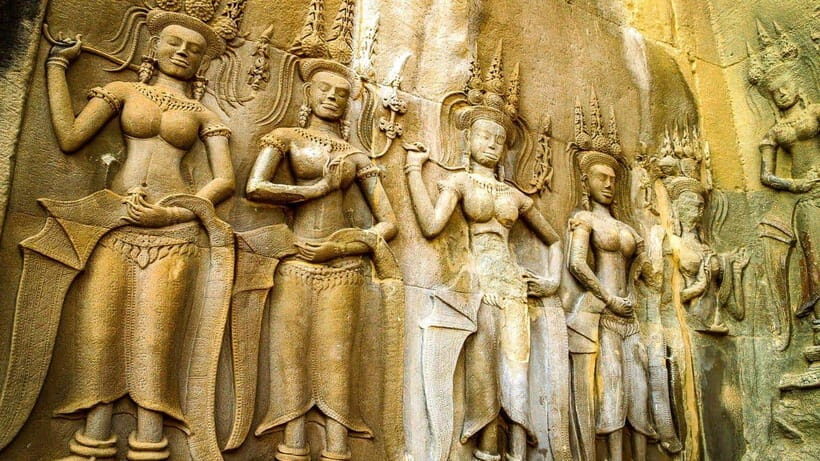
Banteay Srei Temple: small size, detailed carvings
Banteay Srei is the kind of stop people get excited about because it’s smaller than Angkor Wat, but the sandstone work is intricate. You’ll spend time here looking closely at reliefs and ornamentation, and it’s a great place for a guide to explain how the Khmer craftsmen worked and what you’re looking at.
This is also a good day to pace yourself. A lot of early Angkor days feel like sprinting. Here, the smaller temple helps you slow down for a bit and actually look.
Neak Pean: a Buddhist temple on a man-made island
After lunch, you visit Neak Pean. It’s on a man-made island and feels more secluded than many of the other stops. That island layout gives a different kind of atmosphere—more reflective, less “grand parade route,” and it helps break the day into sections.
Other Angkor Wat temple tours we've reviewed in Siem Reap
Preah Khan Temple: large, atmospheric, and easy to get caught in
Preah Khan is a large and atmospheric complex. This is the kind of place where the size makes you understand why Angkor worked as a system. It’s not just one temple. It’s networks of sacred space.
If you’re sensitive to heat, you’ll appreciate the tour’s structure here. You’re not expected to do everything in one continuous stretch. Transport and cooling breaks help you keep your energy for actual exploring.
What I like about Day 1 overall: you get temple variety without feeling chaotic. A lot of the best moments are the ones where your guide points out details you’d otherwise miss—especially in carving work and layout.
Day 2 sunrise at Angkor Wat: the early pickup is the whole point
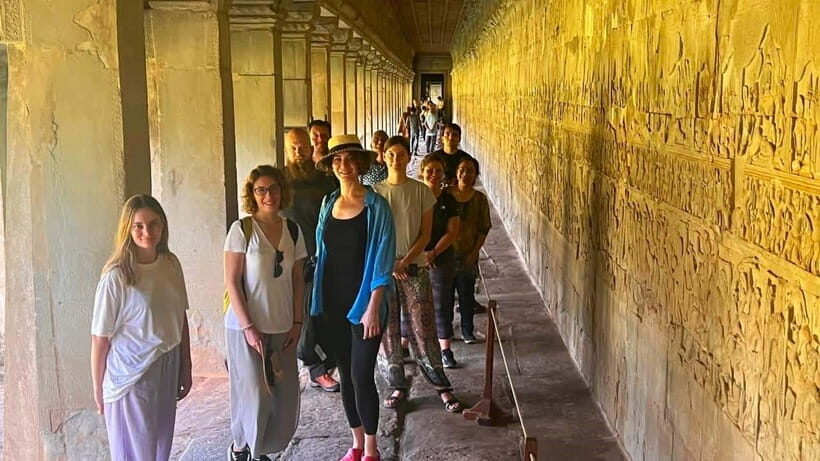
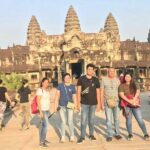
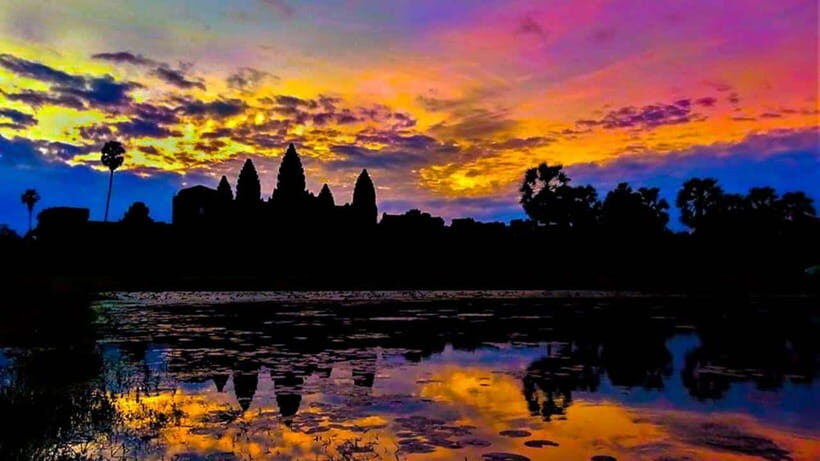
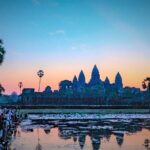
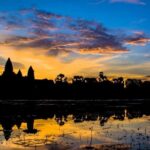
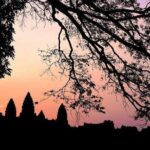
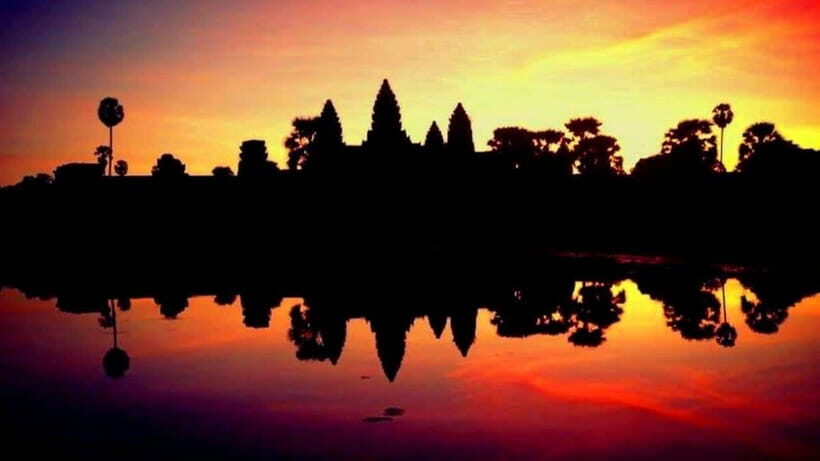
Day 2 starts ridiculously early. Pickup is between 4:20am and 4:35am, and you head to Angkor Wat in the pre-dawn dark. The goal isn’t just to show up and hope. It’s to be in position when the light hits the stone.
Angkor Wat is the world’s largest religious monument, and sunrise here has a specific feeling: the scale becomes obvious in a way photos can’t fully recreate. You’re also seeing the temple before the worst heat and before the crowds swell.
Here’s what you do on arrival:
- You watch the sunrise over the temple complex
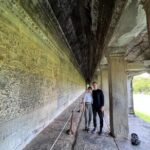
- You explore inside Angkor Wat, including corridors, central chambers, and upper terraces
- You have breakfast just outside the site
- Then you rest before heading to Ta Prohm
That breakfast-and-rest step matters. Angkor Wat can make you hungry fast, and the sun ramps up quickly. Taking a breather before the next jungle stop helps you keep enjoying the day instead of just surviving it.
One more practical point: some guides are known for steering people toward great photo spots. If that matters to you, ask your guide early in the morning where the best views are and when you’ll have the easiest shots.
Ta Prohm to Bayon: tree roots, then stone faces, then more stairs
After sunrise and breakfast, the tour keeps moving but in a logical sequence. You go from atmosphere to meaning. And you go from “lost-in-jungle” to “fortified city energy.”
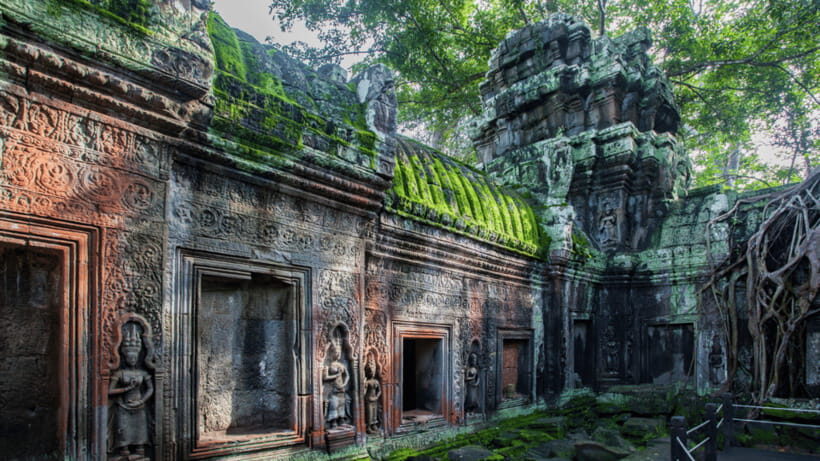
Ta Prohm: overgrown and photogenic in a very real way
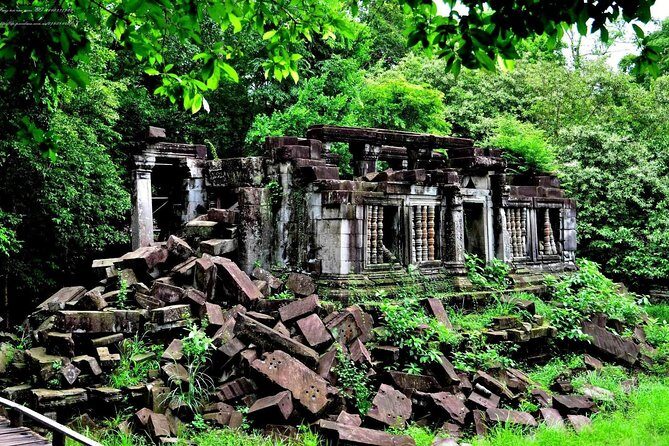
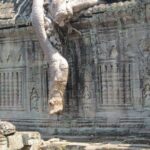
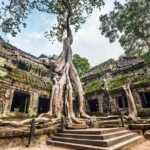
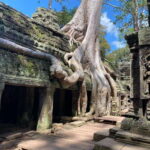
Ta Prohm is the famous temple complex overgrown with trees. It’s visually striking, yes. But what I like is that it doesn’t feel like a staged set. The trees and stone create a lived-in feel, and that’s exactly why people fall in love with Angkor’s physical presence here.
Expect uneven ground and lots of walking. This is also a great temple for photos, and many guides have strong practical instincts about angles and timing.
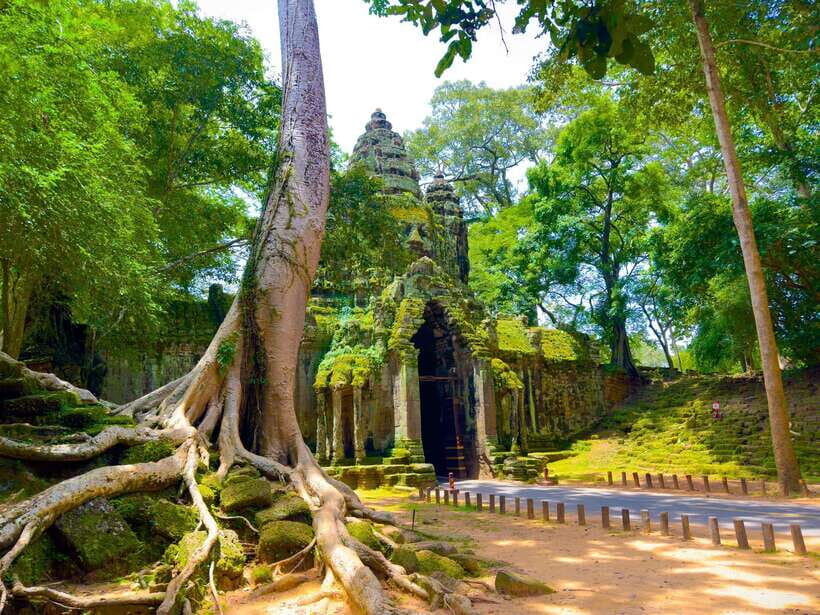
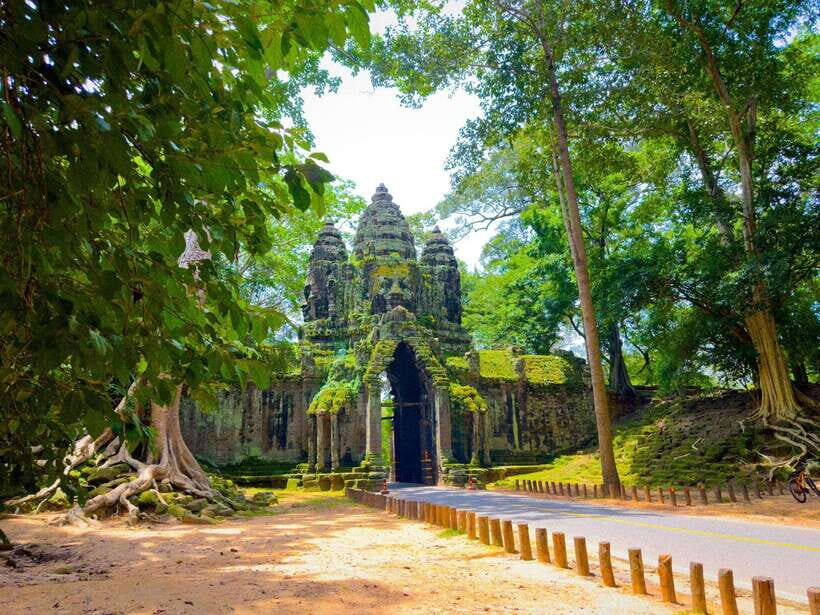
Eastern Gate of Angkor Thom: gods and demons along the entrance
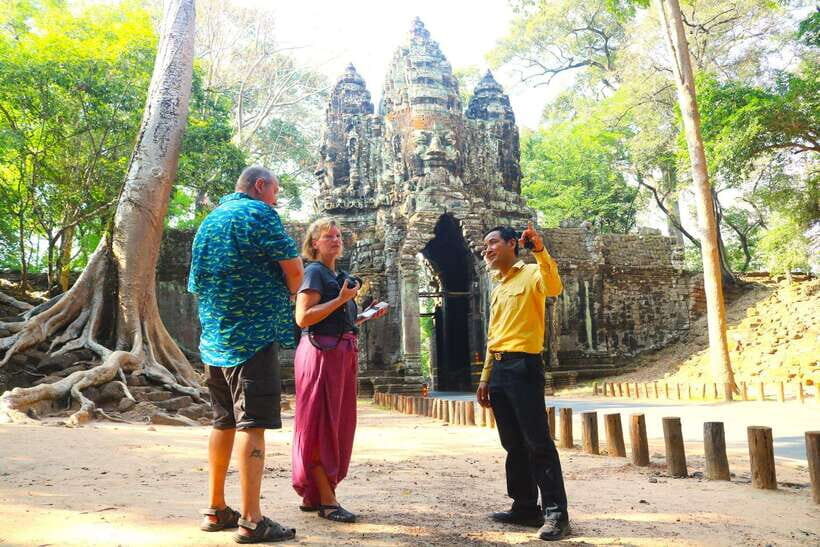
Next you hit the Eastern Gate of Angkor Thom, flanked by a row of stone gods and demons. It’s one of those entrances that immediately tells you that Angkor Thom was built like a defensive and ceremonial capital.
This is a good “mental reset” stop. It helps you shift from individual temples to the bigger idea of a whole city of sacred spaces.
Bayon Temple: those faces never get old
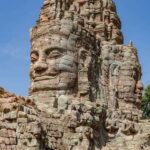
Bayon is famous for its many carved faces. Standing there, you realize it’s not only about the feature people recognize. It’s also about symmetry, scale, and how the carvings guide your attention through space.
Terrace of the Elephants and the Leper King: the quieter story beats
To round out the fortified city, you pass by and visit key areas including:
- Terrace of the Elephants
- Terrace of the Leper King
These spots can feel less famous than Bayon, but that’s why they’re valuable. They give you a sense of how Angkor Thoms’ ceremonial life might have played out. Also, they add variation in the kind of walking you do—more time moving around courtyards and terraces rather than only climbing the tallest features.
Day 2 ends mid-day. That’s a real win, because you can actually use the rest of your time in Siem Reap without feeling wrecked.
Guides, drivers, and why the small-group format matters in real life
The quality of this tour isn’t only in the temples. It’s in how the day feels between sites.
A lot of guides (Sak, Pal, Bun, Chhay, and others) are praised for explaining history tied directly to what you’re seeing. Instead of long lectures, you get practical context: what the carvings might mean, how the religious mix evolved, and why certain features matter. Guides also tend to give just the right amount of free time to explore on your own, so you’re not forced into a single-file mindset.
Then there’s the driver part, which is quietly important at Angkor. Safe driving, punctuality, and comfort on the route matter when you’re doing early mornings plus heat. Many passengers highlight the same comfort pattern: cold water and wet towels after walking stretches.
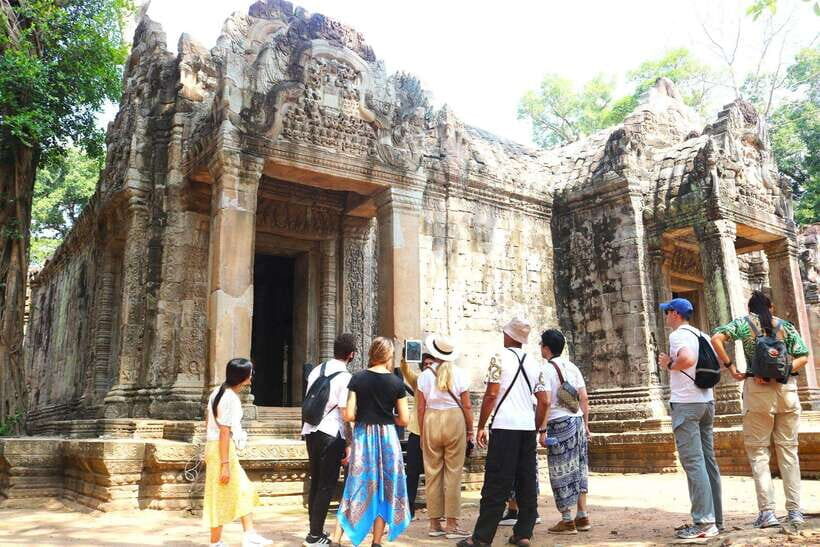
Group size is described as small-group, and some bookings show a group around five people on Day 1, with a larger but still manageable group later (around 11 on Day 2). Either way, the format is built to keep you from feeling like you’re in a moving bus crowd.
Price and value: $16 is the bait, the temples pass is the reality
The tour price is listed at $16 per person, but the temples pass is not included. You’ll need to plan for that separately: a 2–3 day pass is $62 per person.
So the real math is:
- You’re paying for hotel pickup/drop-off, guide, air-conditioned vehicle, and bottled water + cool towels.
- You’re still paying for the temples access through the separate pass.
- Food and additional drinks are also not included.
Is it good value? I think so, because the included comforts are not fluff. Angkor days drain you. An air-conditioned vehicle, water, and cooling towels reduce fatigue fast. You also pay for a guide who helps you understand the sites while you’re there, which turns “I saw temples” into “I got it.”
If you already know you’ll buy a multi-day temples pass anyway, the tour price becomes easier to justify. If you’re only considering doing one day of temples total, you might want to compare whether a smaller one-day plan would fit your budget better.
What to bring, what to expect, and the heat-proof checklist
Angkor is outdoors. That sounds obvious until you’re sweating on stone steps at 9:00am.
Bring:
- Comfortable shoes (sturdy enough for stairs)
- Sunglasses and sunscreen
- Sun hat
- Insect repellent
- Comfortable clothes
Also, pack with the reality of long days:
- Day 1 ends around 4–5pm
- Day 2 ends around 12:30–1:30pm, but you’ll start at 4:20am
Not allowed: pets.
And the tour isn’t listed as suitable for:
- Children under 8
- Wheelchair users
If you’re traveling with kids, plan around their stamina first, because even with breaks, temple days still mean real physical effort.
Should you book this Angkor 2-days sunrise tour?
Book it if:
- You want sunrise at Angkor Wat plus major temples in a tight window
- You’d rather pay for a guide than figure out temple meaning and routing yourself
- You appreciate heat-management basics like air-conditioning and cooling towels
- You’re okay with stairs and long walking days
Skip it or consider an alternative if:
- You’re very sensitive to early mornings or sleep loss
- You can’t handle walking/climbing temple stairways
- You’re hoping sunrise will be guaranteed on any weather day
If you’re doing Angkor in a short visit, this is a practical way to get both the iconic sunrise moment and a broader view of Angkor’s temple variety—without spending your time stuck in logistics.
FAQ
Do I need a temples pass for this tour?
Yes. The tour does not include the temples pass. A 2–3 day pass is listed at $62 per person.
What time does pickup happen on each day?
Day 1 pickup is between 7:45am and 8:00am, with drop-off between 4:00pm and 5:00pm. Day 2 pickup is between 4:20am and 4:35am, with drop-off between 12:30pm and 1:30pm.
Is the tour in English?
Yes. The live tour guide is listed as English.
What’s included in the price?
Included items are hotel pickup and drop-off, a guide, an air-conditioned vehicle, plus complimentary bottled water and a cool towel.
What should I bring for the temples?
You should bring comfortable shoes, sunglasses, a sun hat, sunscreen, comfortable clothes, and insect repellent.
Is sunrise guaranteed?
Sunrise depends on the weather, so it’s not something you can fully guarantee.
Can I skip the ticket line?
The tour is listed as offering skip-the-ticket-line service.
How long is the tour?
It’s listed as 1–2 days, with this specific format running as two days. Day 1 runs to about late afternoon, and Day 2 ends mid-day.
Can I cancel for a refund?
Yes. Free cancellation is listed up to 24 hours in advance for a full refund.