REVIEW · SIEM REAP
Angkor Wat Bike Tour with Lunch Included
Book on GetYourGuide →Operated by The Guide Cambodia Travel · Bookable on GetYourGuide
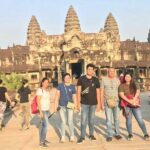
Two wheels make Angkor easier to digest, and this Angkor Wat bike day turns the huge temple complex into a moving route. You’ll start at Angkor Wat, then pedal out through forest paths to big landmarks like Ta Prohm and Bayon, plus one calmer jungle stop.
I like the Giant mountain bikes a lot: disc brakes, front suspension, and lots of gears for the mix of packed dirt and some paved stretches. I also like having Pok as a guide when he’s leading, because he’s skilled at spotting the details and helping with photos, so you get more than postcard views.
One thing to plan for: the temple pass is not included, and you’ll be riding outdoors for most of the day, so bring sun protection and be ready for a few bumpy bits.
In This Review
- Key points to know before you go
- Why cycling your way through Angkor makes sense
- Pickup, timing, and how the ride is organized
- Angkor Wat before you pedal: carvings, layout, and orientation
- Ta Prohm at bicycle pace: roots, stone, and the movie connection
- 11:30 lunch break: clean, local, and timed right
- Ta Nei Temple: the jungle ruin stop most people miss
- Angkor Thom and Bayon: the 13th-century city and Avalokiteshvara faces
- Terrace of the Elephants: watching the Khmer king’s world
- The ride details that make the day comfortable
- English guide + photo help: why you’ll get better memories
- Price and value: what $55 buys you (and what it doesn’t)
- Who this tour fits best
- My decision: should you book this Angkor Wat bike tour?
- FAQ
- How much does the Angkor Wat bike tour cost?
- How long is the tour?
- Is lunch included?
- What’s included with the biking?
- Do I need a temple pass?
- How large is the group?
- Is free cancellation and reserve-and-pay-later available?
Key points to know before you go
- Small group (max 8) keeps the pace comfortable and questions easy.
- Giant bikes with disc brakes and suspension make the ride more controlled on dirt paths.
- Pok (often leading) is strong with photos and explains what you’re seeing in plain language.
- Ta Prohm’s roots and Tomb Raider filming link makes this stop instantly memorable.
- Ta Nei Temple on the way gives you a quieter look at ruins deeper in the jungle.
- Lunch plus fruit keeps you fueled without hunting for food between temples.
Why cycling your way through Angkor makes sense
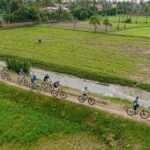
Angkor can feel like a maze if you do it only by car or tuk-tuk. A bike tour gives you something different: speed, but also that slower, human scale. You can stop when something catches your eye, wait for the light, and get photos from angles you don’t get from inside a vehicle.
This tour is built for that. You spend time at the big hitters, but the route also includes jungle riding and a less crowded temple stop. That balance matters, especially if you only have a limited window in Siem Reap and you don’t want to spend your day just driving between points.
Other Angkor Wat temple tours we've reviewed in Siem Reap
Pickup, timing, and how the ride is organized
The day starts with hotel pickup around 8:30 am. You’ll go in a tuk-tuk or car to the Angkor Wat area. That matters because you don’t waste time figuring out transport, and it’s much easier than trying to coordinate bikes on your own first thing in the morning.
You’ll spend the early window at Angkor Wat before the cycling portion begins. At 10:00 am, you start riding toward Ta Prohm. The schedule is set up so you’re cycling through several key parts of the complex in the morning, then you pivot to lunch, a jungle temple, and Angkor Thom after.
You’ll finish around 3:00 pm, with fruit served before you head back to your accommodation by tuk-tuk. For a 7-hour tour, that’s a tight, well-packed day without feeling like a nonstop sprint.
Angkor Wat before you pedal: carvings, layout, and orientation
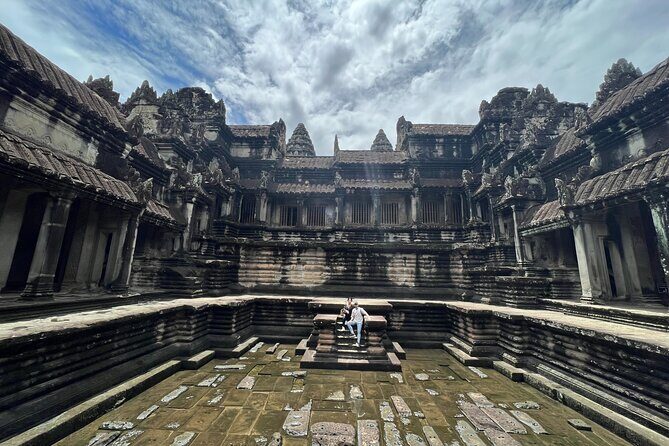
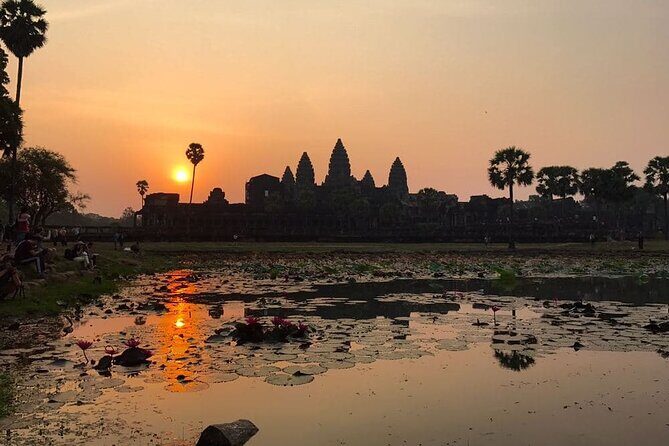
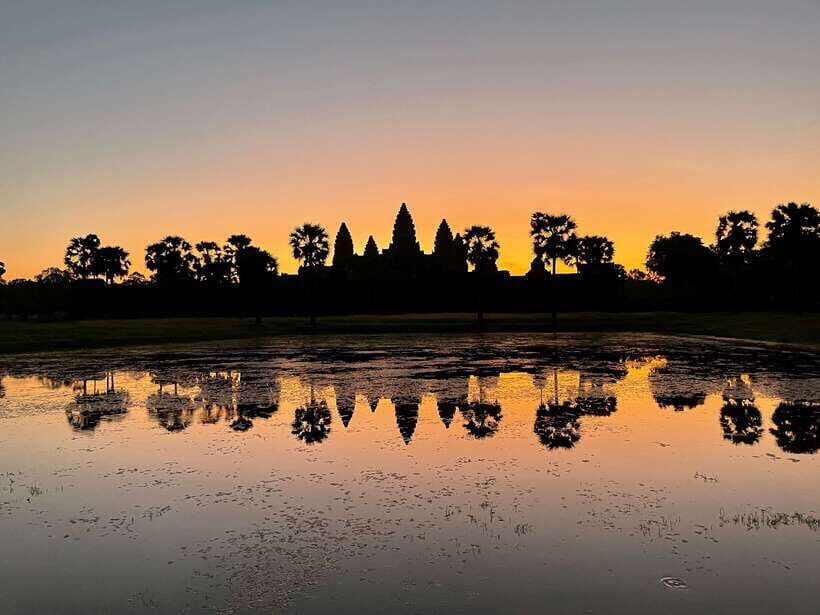
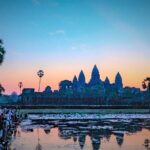
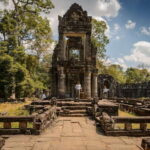
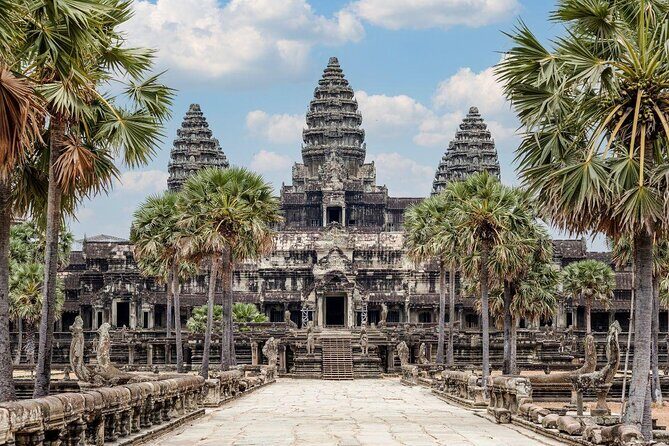
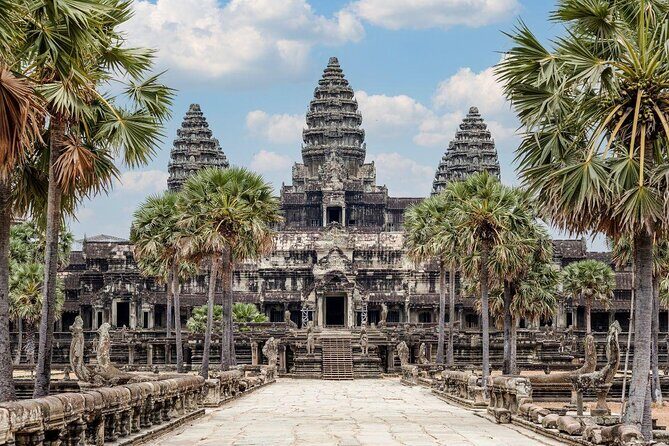
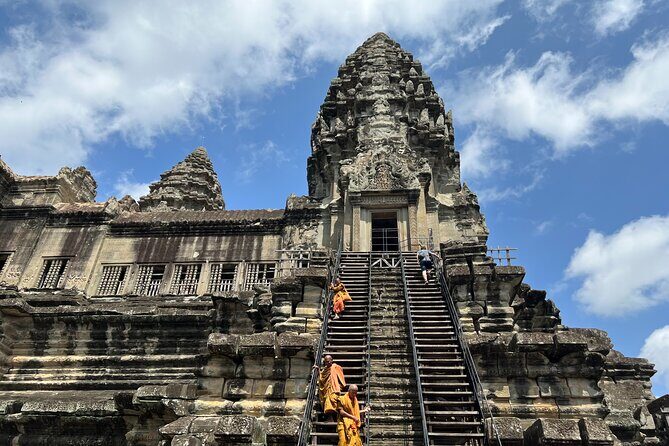
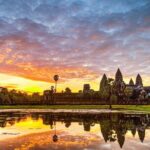
Angkor Wat is the anchor. It’s often described as the masterpiece of the Khmer temples, and the reason is pretty simple: you’re looking at a whole system of design, not just a single impressive building. Even if you don’t know the names of every carving, you can still read the structure—gate to courtyard, axis to basins, and the layered feel of the architecture.
Arriving before cycling helps you get your bearings. Then when you ride later, you’re not just moving through space—you’re connecting the visuals to what you saw on foot earlier.
A practical note: temple grounds can be busy. Going early gives you a better shot at clearer views, and your guide can help you make smart stops rather than wandering.
Ta Prohm at bicycle pace: roots, stone, and the movie connection
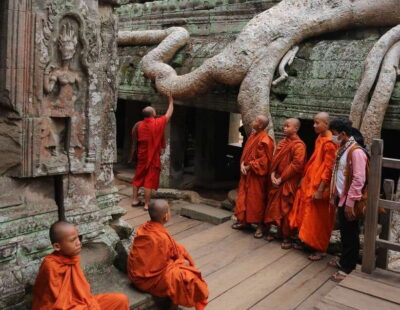
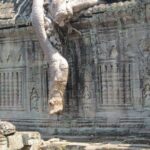
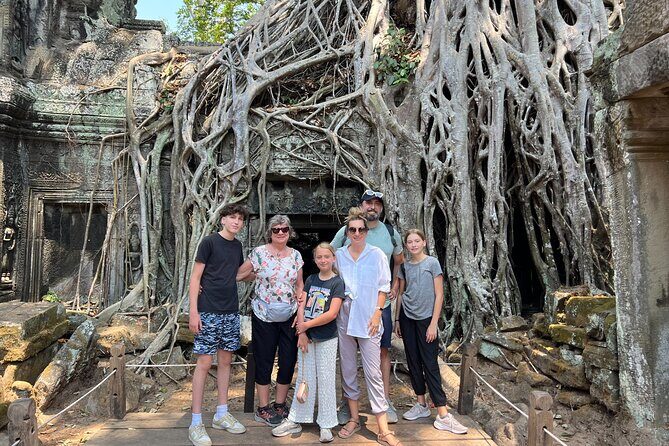
At 10:00 am, you cycle to Ta Prohm. This is the temple people remember because of the trees. Their roots and trunks intertwine with the ancient stones, and it creates that tangled, dramatic look that feels half ruin, half living forest.
There’s also a pop-culture hook here. Ta Prohm is tied to the movie Tomb Raider with Angelina Jolie, which helps you understand why so many people instantly recognize the scene. Even if you’re not chasing movie trivia, it’s a stop that hits fast: the visuals do the talking.
What I like about seeing it by bike is that your body is in motion. You’re not trapped waiting behind a crowd line. You can shift your angle, watch how the roots frame doorways, and let your guide point out the details you might otherwise walk past.
11:30 lunch break: clean, local, and timed right
At 11:30 am, you stop for lunch at a local restaurant. The value here is that lunch is included, and it’s served at a point in the day when you’re actually ready to refuel. You’re already warmed up by cycling, and you’ll still have enough time afterward to keep going without feeling rushed.
In particular, I appreciate that the lunch stop is described as clean and well-run. Also, your day isn’t only about temples; the organizers make sure you get a normal food break rather than just grabbing something and jumping back on the bike instantly.
Other cycling tours in Siem Reap
Ta Nei Temple: the jungle ruin stop most people miss
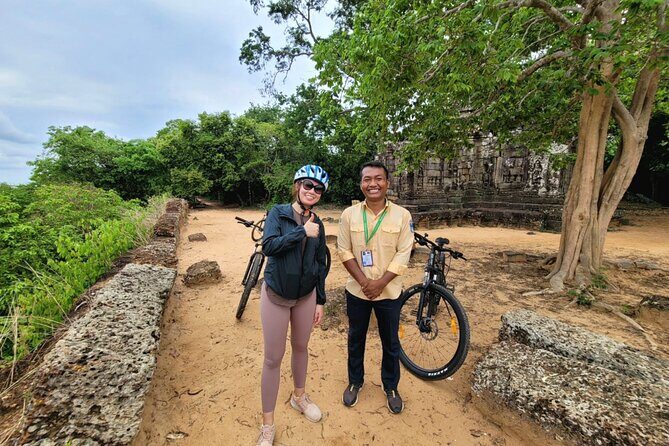
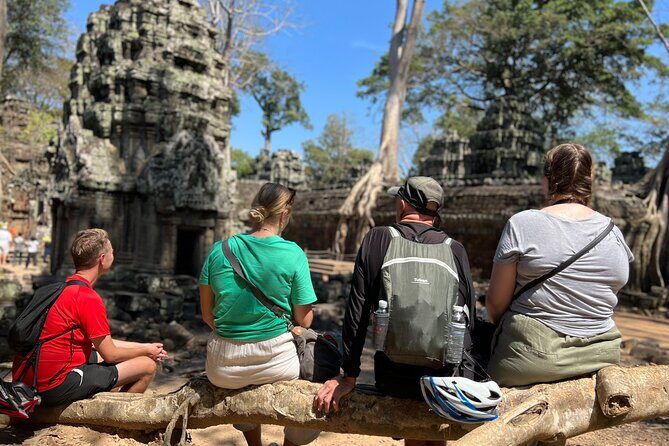
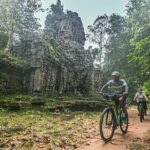
After lunch, the next move is Ta Nei Temple around 1:00 pm. This one is less about grand scale and more about atmosphere. You’re heading to ruined structures in the jungle, and that setting changes how you experience the stones. Instead of a foreground crowd, it feels like you’re stepping into a pocket of time.
The best practical reason to include Ta Nei is simple: it breaks up the day so you’re not only hitting the most famous names in a row. It also makes the cycling feel worth it. If you’re doing Angkor only as a checklist of the big five, you miss the sense of route and discovery that comes from riding between them.
Angkor Thom and Bayon: the 13th-century city and Avalokiteshvara faces
At 2:00 pm, you ride to the east gate of Angkor Thom and visit Bayon Temple. Angkor Thom is the ancient city from the 13th century, and Bayon is its standout with those famous stone faces.
These faces are described as Avalokiteshvara and connected to the Mahayana Buddhist king Jayavarman VII. That context matters. Without it, Bayon can turn into a photo wall. With it, you start to see it as a statement of power, devotion, and city planning—an entire political and religious message carved into stone and placed where people would move through daily.
A tip I’d give you: don’t only photograph the biggest face you spot. Ask your guide for a couple of close-looking points. When you do that, Bayon’s repetition becomes interesting instead of monotonous.
Terrace of the Elephants: watching the Khmer king’s world

After Bayon, the tour continues to the Terrace of Elephants. This is described as the main terrace where the king sat to observe the training of elephants. It’s one of those places where the stone isn’t just decoration—it’s theater. Even if you never see elephants in person, the design tells you how important elephants were to royal life and power.
This stop is also a good pacing change. You’ve been cycling and climbing and peeking into courtyards. Terraces give you a place to pause and look across the site, and your guide can connect what you’re seeing to the wider Angkor story.
The ride details that make the day comfortable
This tour includes the hard essentials that often get skipped on other bike experiences.
You get modern, high-quality mountain bikes (Giant), plus:
- large gear sets
- disc brakes
- good front suspension
- helmet
- bottle water
- support transportation following along
- hotel pickup and drop-off by tuk-tuk or car
That support transport detail is more useful than it sounds. It means if someone needs a rest, the day doesn’t fall apart. It also helps your guide keep time without pushing you too aggressively.
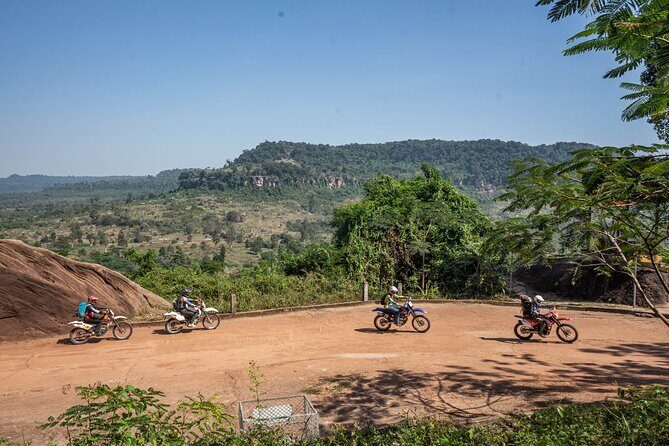
As for the riding itself, the paths are described as hard packed dirt, with some paved sections and minimal traffic. Translation: you’re not dealing with chaotic streets, but you are cycling outdoors and you should expect uneven ground and dust.
If you’re sensitive to dust, wear something that covers your nose and mouth a bit, and bring sunglasses. You’ll be happier that way.
English guide + photo help: why you’ll get better memories
For me, the biggest value add on a bike tour isn’t the bike. It’s the guide’s ability to turn stone into meaning.
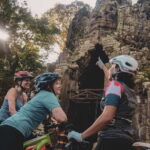
Pok is highlighted as a wizard with photos and as someone who answers questions and shares helpful details along the route. Meam is also mentioned as very knowledgeable, and what both seem to have in common is that they make stops easy to understand without turning the day into a lecture.
You’ll also likely get hands-on help with photos. That matters because Angkor’s best angles aren’t always obvious, and it helps to have someone who knows where to stand.
Price and value: what $55 buys you (and what it doesn’t)
The price is $55 per person for a 7-hour tour, and it’s not just a bike rental.
Your cost includes:
- professional English speaking guide
- Giant mountain bike with helmet
- bottle water
- lunch
- fresh fruits
- hotel pickup/drop-off
- support transportation
What’s not included is the temple pass and personal expenses. So the real budget picture is: plan to add the temple pass on top of $55.
Still, for many visitors, this is good value because it bundles your biggest friction points. Buying a pass and entering temples is one thing. Getting there, arranging bikes, dealing with traffic, and finding quieter routes is another. Here, you outsource all that stress to the organizer and focus on the riding and the sights.
Also, small group size (limited to 8 participants) helps you avoid the feeling of being squeezed. With fewer people, your guide can slow down for meaningful stops and keep photo opportunities from turning into a rush.
Who this tour fits best
This is a great match if you:
- want a balanced overview of Angkor Wat, Ta Prohm, Ta Nei Temple, Bayon, and Angkor Thom
- like biking and don’t mind hard packed dirt
- want a guide who can explain what you’re seeing, not just point in a direction
- have limited time in Siem Reap and want a structured route that still feels flexible
It might not be ideal if you:
- dislike cycling for hours on outdoor paths
- want a completely unhurried, temple-only day with no riding segments
- prefer to travel without a set schedule
My decision: should you book this Angkor Wat bike tour?
Yes, I’d book it if you want the Angkor complex to feel like a route, not a checklist. The mix of major temples plus a jungle ruin stop gives you variety, and the included bikes and lunch make it low-effort once you’re there.
The one “do it now” item is planning for the temple pass since it’s not included. If you’ve got that covered and you’re comfortable riding several hours, this is one of the more practical ways to experience Angkor without burning your day on logistics.
FAQ
How much does the Angkor Wat bike tour cost?
It costs $55 per person.
How long is the tour?
The duration is 7 hours.
Is lunch included?
Yes. Lunch is included, and you’ll also get fresh fruits toward the end of the tour.
What’s included with the biking?
You get a modern mountain bike (Giant) with disc brakes and front suspension, plus a helmet and bottle water. Support transportation and hotel pick-up/drop-off are also included.
Do I need a temple pass?
Yes. The temple pass is not included, so you’ll need to purchase it separately.
How large is the group?
The group is limited to 8 participants.
Is free cancellation and reserve-and-pay-later available?
Yes. You can cancel up to 24 hours in advance for a full refund, and you can reserve now and pay later.