REVIEW · SIEM REAP
Private Day Angkor Wat Temple and Banteay Srei Temple Tour
Book on Viator →Operated by Angkor Guide Tour · Bookable on Viator
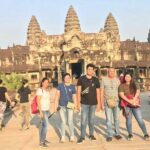
A private Angkor day, paced for real seeing. This tour is interesting because it strings together the vine-choked drama of Ta Prohm, the jewel-box precision of Banteay Srei, and the big signature sights of Angkor Thom and Angkor Wat, all in one long day. I also liked how the guide worked fast and clearly—one guide, Chanra, coordinated through WhatsApp and helped customize what we focused on—so your time doesn’t feel cookie-cutter. Even better, I liked the practical flexibility for real-world limits: when someone in the group was on crutches, the guide arranged transport closer and used a mix of moped and tuk-tuk so she wouldn’t miss the main sites.
The main drawback to know up front: you’re covering a lot of ground in about 8 hours 30 minutes, and the temple pass isn’t included (you’ll need that separate ticket). If you’re very sensitive to stairs, uneven paths, or long walks, you’ll want to talk to your guide before the day gets started so you can plan your pacing and stops.
In This Review
- Key things I’d zero in on before you go
- How this 8.5-hour private route keeps Angkor from feeling like a blur
- Ta Prohm: the Rajavihara monastery and the feeling of getting lost
- Pre Rup: a short stop with big temple-king context
- Banteay Srei: why Pink Ladies Temple rewards slow looking
- Angkor Thom South Gate to Bayon: faces, causeways, and symbolism
- Baphuon, Phimeanakas, and the royal terraces: where the “royal” really shows
- Angkor Wat: the main temple deserves the 3-hour focus
- Price, tickets, and whether the day is good value
- Who this tour suits best (and a quick mobility reality check)
- Should you book this Angkor Wat and Banteay Srei private day?
- FAQ
- What’s the duration of the Private Day Angkor Wat and Banteay Srei tour?
- Is this tour private?
- Is pickup included?
- Do I need to buy a temples pass?
- What’s included in the price besides the guide?
- How long is the stop at Angkor Wat?
- What other temples are included on the itinerary?
- What are the operating hours?
- What’s the cancellation policy?
Key things I’d zero in on before you go
- Private, just your group: you get a calmer pace and fewer waiting games than on big buses.
- English guide who explains as you go: you’ll understand what you’re looking at, not just where to stand.
- A route that balances the “wow” with the detailed stuff: Angkor Wat plus Banteay Srei’s carvings and Ta Prohm’s roots.
- Air-conditioned vehicle, cool water, and towels: helpful in Siem Reap heat when you’re out all day.
- Real flexibility for mobility needs: arrangements can be made so you’re not forced into a “walk it all” day.
- Temple pass required separately: plan for the added cost so the day stays smooth.
How this 8.5-hour private route keeps Angkor from feeling like a blur
Angkor can feel like a theme park if you’re rushing. The value of this private day is that your guide can move you through a logical sequence while still giving you time at each stop. The tour lasts about 8 hours 30 minutes, with shorter visits at several temples and a longer focus at Angkor Wat (about 3 hours). That matters because most people don’t need 90 minutes everywhere—they need enough time to understand the place, catch the details, then get to the next without being stranded in crowds.
Transport is handled with an air-conditioned vehicle, plus parking fees and road tolls are included. You also get cool water and towels, which sounds small until you’re walking in the sun between sites. This isn’t a casual “stroll and snack” kind of day; it’s a smart sightseeing circuit.
One more practical note: you’ll be visiting temples that each have their own vibe—jungle ambience at Ta Prohm, Hindu storytelling in Banteay Srei, and the political-religious center at Angkor Thom. With a private guide, you can shift your attention to what you enjoy most, instead of being herded like a checklist.
Other Angkor Wat temple tours we've reviewed in Siem Reap
Ta Prohm: the Rajavihara monastery and the feeling of getting lost
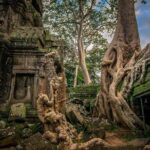
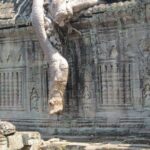
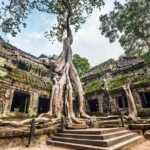
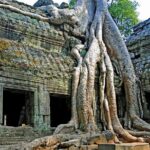
Ta Prohm is the kind of place where your brain keeps saying: wait—how is this still standing? The temple’s original name was Rajavihara, meaning monastery of the king, and it functioned as a Mahayana Buddhist monastery and university. The construction date is commonly given as 1186 AD, and what you notice first is the jungle setting.
The defining feature here is the way the ruins and the trees are tangled together. You see giant roots sprawling across the structures and vines that create a labyrinth effect over the stone. Even if you’ve seen photos, the scale in person can still surprise you. The roots feel like living architecture, not decorations.
Time-wise, you’ll have about 1 hour at Ta Prohm. That’s enough to wander slowly, pause for photos, and still leave while you still have energy for the rest of the day. The main consideration is that walking paths can be uneven and the ground can be slippery. If you need closer access, this is where you’ll appreciate the guide’s ability to adjust how you move (as seen with the moped/tuk-tuk arrangement for a crutch user).
Pre Rup: a short stop with big temple-king context
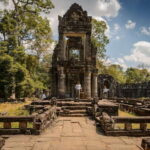
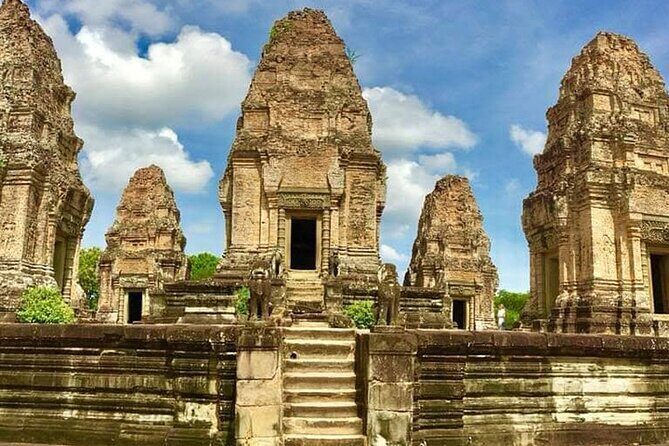
Next comes Pre Rup, built as the state temple for King Rajendravarman in the late 10th century, with a date often given as 961 or 962 AD. It’s scheduled for about 20 minutes, so treat it as a quick “read the place” stop rather than a long linger.
Even with a short visit, Pre Rup helps you understand the pattern behind many Angkor temples: they’re not random ruins. They were designed to connect rulers, religion, and the idea of order in the universe. If you’re the type who likes a little context before you hit the bigger monuments, Pre Rup is a good warm-up.
Banteay Srei: why Pink Ladies Temple rewards slow looking
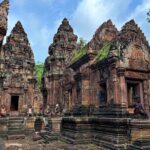
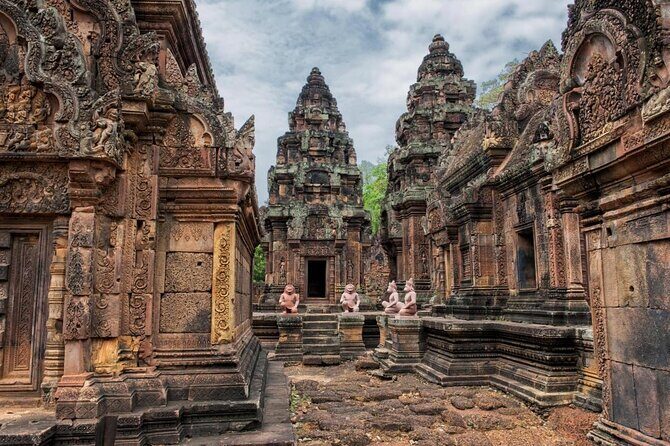
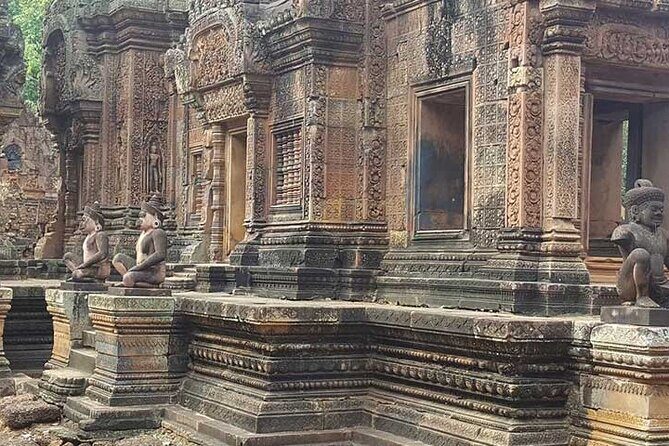
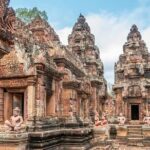
If Angkor Wat is the headline, Banteay Srei is the detail work. This is the 10th-century Temple of Women (also called the Pink Ladies Temple), dedicated to Shiva. It’s known for its Khmer art and especially its intricate carving—motifs, figures of gods, and fine sculptural work that’s easier to appreciate when you’re not rushing.
The tour allots about 1 hour here. That’s a sweet spot. Banteay Srei is smaller than many other temples, so you can actually study surfaces without feeling like you’re constantly chasing the next entrance. This is the stop where I’d tell you to slow down and get your eyes back from the phone. The carving is the whole point.
Also, it sits near Phnom Dei, about 25 km north-east of the main Angkor area, so it feels a bit like a breath of fresh air compared to the core crowds.
Angkor Thom South Gate to Bayon: faces, causeways, and symbolism
Angkor Thom is the old royal city core, and the tour enters from the South Gate. Approaching the city, you cross a causeway over a 100 m wide moat. The sides are lined with a naga balustrade, including a massive stone carving of a seven-headed naga. This gate sets the tone: you’re not just walking into a temple; you’re stepping into a designed world of myth and power.
From there, you move to Bayon Temple, which is famous for its 173 gigantic faces on the towers. It’s one of those places where your eyes keep moving because the faces seem to look back from every angle. Local Khmer belief connects the faces to powerful concepts, and the site has long sparked theories about who or what the faces represent.
You’ll have about 50 minutes at Bayon, which is enough to walk key viewpoints and still absorb what you see. The temptation is to spend all your time photographing faces from the closest spots. Instead, I like using the 10-minute rhythm: look wide first, then step in for details, then look wide again so you can understand the composition.
Other Banteay Srei tours we've reviewed in Siem Reap
Baphuon, Phimeanakas, and the royal terraces: where the “royal” really shows
After Bayon, you’ll visit several structures inside the royal enclosure area.
Baphuon is the state temple of King Udayadityavarman II, located between the Royal Palace and Prasat Bayon. The sandstone monument is a major part of the area’s story, and the stop runs about 40 minutes. This is a good time to switch from “faces and gates” to “structure and kingdom.” Baphuon helps connect the visual style to the political geography of Angkor Thom.
Then you’ll go to Phimeanakas, described as a temple with a story and part of the royal enclosure. The scheduled time is about 30 minutes. For me, this is one of those sites where the size isn’t the draw—the connection to royal grounds is.
Finally come the terraces, which are built for display and ceremony. The tour includes:
- Terrace of the Elephants (about 30 minutes) built by King Jayavarman VII at the end of the 12th century. It runs for more than 300 meters from near Baphuon in the south toward the Leper King terrace in the north.
- Terrace of the Leper King (about 15 minutes). It’s part of the royal terraces group and faces the parade grounds.
These terrace stops are short, but they matter because they show Angkor isn’t only temples set in forest. It’s also a stage. Terraces were built for gatherings and processions, so even a brief visit helps you picture the ceremonies that once took place here.
Angkor Wat: the main temple deserves the 3-hour focus
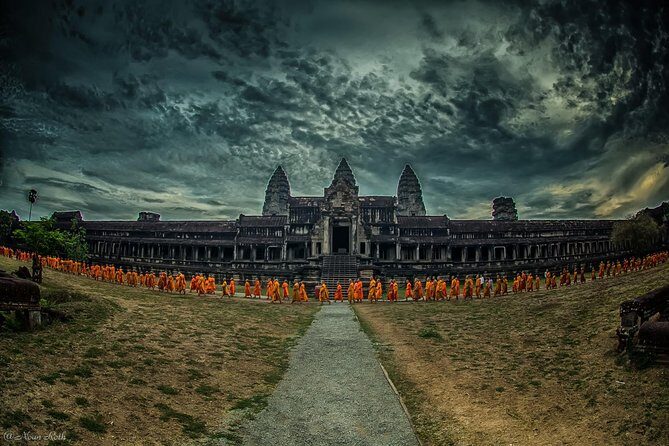
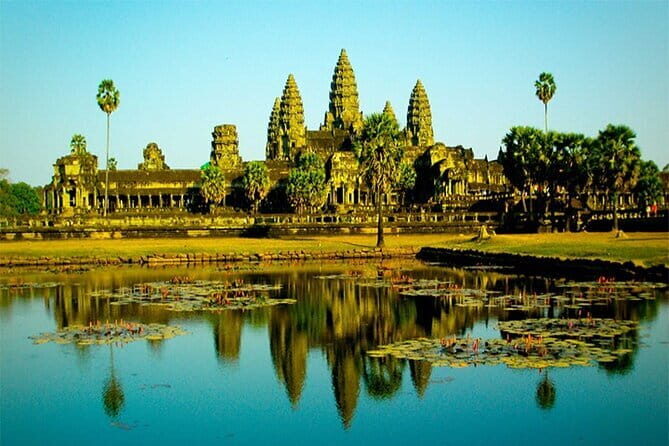
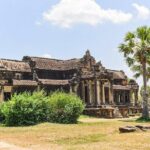
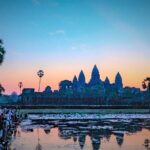
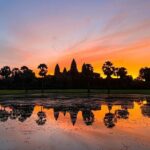
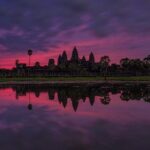
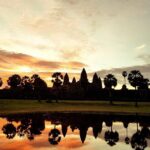
Then you reach Angkor Wat, the big finish. It’s the largest of Angkor’s temples and is often described as representing the abode of Hinduism’s ancient gods—literally heaven on earth in Khmer imagination. The tour gives you about 3 hours, and that length is right. Angkor Wat rewards time spent in the right order.
Here’s the basic idea to carry with you: Angkor Wat has a layout with five concentric rectangular walls and moats alongside. That symbolism points to a cosmic pattern—mountains and ocean. The central tower represents Mount Meru, often said to be the center of the Hindu and Buddhist universe.
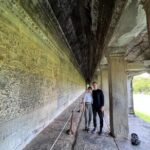
Standing inside and walking through, you’ll start to see how the design guides your movement. The corridors funnel you, the courtyards open up, and the towers keep pulling your eyes back toward the center. With a guide, you’ll understand what features mean rather than only what they look like.
Practical tip: if you’re hungry or sweaty, this is still your chance to slow down and take a breath. Angkor Wat can be mentally exhausting because there’s always another view line, another doorway, another carved surface. Use the full 3 hours. It’s the difference between seeing Angkor Wat and actually understanding it.
Price, tickets, and whether the day is good value
The tour price is $43.00 per person and temples tickets are not included. The temples pass is listed as $37.00 for a 1-day pass. So plan on roughly $80 total per person for the tour plus entry.
Is that worth it? In my view, yes if you’ll use the guide and appreciate a private, efficient route. You’re paying for:
- an English-speaking guide who can explain what you’re looking at,
- an air-conditioned vehicle with parking and tolls handled,
- cool water and towels,
- and a schedule that hits Ta Prohm, Banteay Srei, Angkor Thom, and Angkor Wat without needing to figure out transport between sites yourself.
If you’re the type who can navigate and manage everything on your own, you could save money by hiring a driver and buying tickets separately. But if you want your time to feel smoother—and you want someone to help you prioritize and understand what matters—this price structure is pretty fair.
Also, this is offered as a private tour, meaning only your group participates. That’s when the “value” math starts to favor you, especially if you’re traveling with family or friends and don’t want the constant stop-and-start feeling of larger tours.
Who this tour suits best (and a quick mobility reality check)
This is a smart fit if:
- you want a private experience with an English guide,
- you want to see both major icons like Angkor Wat and the detailed carving focus of Banteay Srei,
- you like structure—knowing you’ll hit key stops in a full day.
It’s also a good choice if mobility is a concern, because the guide can arrange options that keep you from missing everything. I saw this in a real situation where a companion was on crutches and the guide adjusted access by driving closer and using moped and tuk-tuk for part of the route. Still, keep expectations realistic: temples involve uneven ground and stairs. The guide can help, but you’ll still want to plan for comfort.
If you’re traveling with kids, the private format can help a lot because the pace can be adjusted and explanations can stay short and clear.
Should you book this Angkor Wat and Banteay Srei private day?
I’d book it if you want one high-quality day that covers the core Angkor highlights without feeling like a rushed checklist. The mix of Ta Prohm’s jungle drama, Banteay Srei’s fine carving, and the royal-citadel feel of Angkor Thom makes this more interesting than a route that only chases the biggest monument.
I’d hesitate only if you strongly prefer a lighter day with fewer stops, or if you’re fairly sure you’ll struggle with lots of walking even with adjustments. In that case, you might consider a shorter-route option.
If you can handle a full day and you care about understanding what you’re seeing, this tour is a solid pick.
FAQ
What’s the duration of the Private Day Angkor Wat and Banteay Srei tour?
The tour runs for approximately 8 hours 30 minutes.
Is this tour private?
Yes. It’s a private tour/activity, so only your group participates.
Is pickup included?
Yes. Pickup is offered, and the inclusions also mention pick up/drop off at the airport.
Do I need to buy a temples pass?
Yes. A Temples Pass (1 Day) for $37.00 per person is listed as not included, so you’ll need to purchase it separately.
What’s included in the price besides the guide?
Included items are air-conditioned vehicle, English tour guide, parking fees and roads tolls, cool water and towels, and pickup/drop off services.
How long is the stop at Angkor Wat?
The itinerary lists Angkor Wat for about 3 hours.
What other temples are included on the itinerary?
The tour includes Ta Prohm, Pre Rup, Banteay Srei, Angkor Thom South Gate, Bayon, Baphuon, Phimeanakas, Terrace of the Elephants, Terrace of the Leper King, and Angkor Wat.
What are the operating hours?
The experience runs Monday to Sunday from 8:00 AM to 4:00 PM.
What’s the cancellation policy?
You can cancel for a full refund if you cancel at least 24 hours before the experience start time. Free cancellation is offered, and changes inside that window aren’t accepted.