If you want Siem Reap context fast, go. This 4-hour private tour gives you a guided sweep through monasteries and everyday neighborhoods, plus time at the APOPO Visitor Center. You’ll also get a local-market moment where daily life shows up in small, real ways. One heads-up: the plan doesn’t clearly include a national museum stop, so if that museum matters to you, ask before you go.
I like that the pacing is built for a short window: morning or afternoon, after temples or before them. You’ll ride in private transportation with pickup offered, then step out for focused stops around the city center and along the river.
For best value, plan for the one extra cost: APOPO entry is not included and runs $10 per person. If you skip that part, you’ll still see the rest, but you might feel the timing changes.
In This Review
- Key things you’ll notice right away
- Why this 4-hour Siem Reap circuit makes sense
- The flow of the day: Street 08 to craft market
- Stop 1: Street 08 (your start point and city-center primer)
- Stop 2: Wat Preah Prom Rath (monk lifestyle, not just a building)
- Stop 3: Royal Residence area (shrines, bats, and quieter lanes)
- Stop 4: Siem Reap River and a local market stop
- Stop 5: Wat Preah Enkosey Monastery (a riverside older structure)
- Stop 6: APOPO Visitor Center (HeroRATs) and the one extra fee
- Stop 7: Made in Cambodia Market (craftsmanship you can actually browse)
- Stop 8: Transfer back to your hotel (or a drop-off you choose)
- Price and what you’re really getting for $35
- Timing: when 4 hours is perfect (and when it might feel rushed)
- Getting the most out of your guide: what to ask
- What to watch for before you book
- Should you book this Siem Reap highlights tour?
Key things you’ll notice right away
- English-speaking local guide who keeps the story grounded in daily life, not just facts
- Monastery time to understand monk lifestyle in Siem Reap
- Royal Residence area with a shrine, park, and large bats in the mix
- Siem Reap River walk plus a stop at a local market for real-world rhythm
- APOPO Visitor Center (HeroRATs) with entry on top of the tour price
- Made in Cambodia Market for Cambodian craftsmanship and design browsing
Why this 4-hour Siem Reap circuit makes sense
Siem Reap is famous for temples, but the city itself is where you start to understand what those temples mean. This tour is designed as a starter kit for the rest of your trip. You get a city-center introduction, a monastery lens on local spirituality, a river neighborhood walk, and then a move into charity and crafts.
The big value is that you’re not trying to piece together your own route in a place where street names and “how to get there” can feel like a puzzle. With private transportation and a local guide, you spend more time looking at what’s in front of you and less time figuring it out.
Also, the price is surprisingly reasonable for a private tour at this length—especially because you get snacks and you aren’t paying entry fees for most stops. The one paid add-on is APOPO.
Other Siem Reap city and countryside tours we've reviewed in Siem Reap


The flow of the day: Street 08 to craft market
This is a true highlights-with-stops style itinerary. It’s not a long drive day, and it doesn’t try to cram in the big temple complex. Instead, it works like a guided orientation that you can build on later.
Stop 1: Street 08 (your start point and city-center primer)
You begin with an introduction from your guide right in the city center area. It’s a short pause—about 5 minutes—meant for setting expectations and getting the lay of the land.
Why it matters: a few minutes of context can change how you notice everything later. Ask what neighborhoods feel calm versus busy, where locals tend to shop, and what daily routines you’ll see in the river-area market.
Practical note: you’re not paying for entry here. This is a quick start, more like a warm-up than a sight.
Stop 2: Wat Preah Prom Rath (monk lifestyle, not just a building)
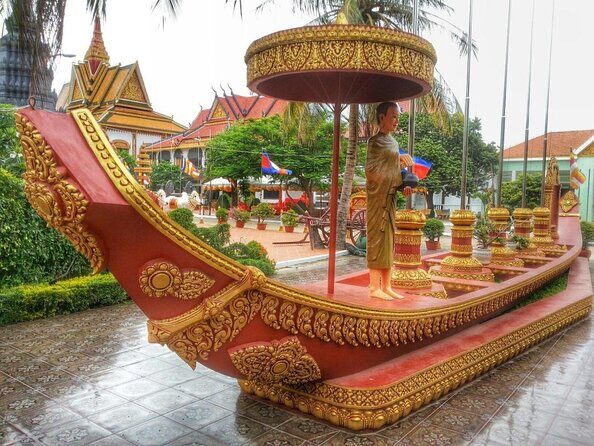
Next comes Wat Preah Prom Rath. This is your first deep breath into monastery life, with time focused on how monks live in Siem Reap.
Planned time is about 20 minutes, and entry is free. That’s enough time to understand the basics without turning it into a long sit-down tour.
What I’d do: pay attention to what your guide emphasizes—daily routine, local religious practice, and the human side. The monastery part is one of the most meaningful stops on the route because it connects culture to everyday behavior, not just stone and architecture.
Stop 3: Royal Residence area (shrines, bats, and quieter lanes)
You then stop around the Royal Residence area. This is described as a mix of a local shrine, a park where large bats live, and a nearby residential zone that feels more local and quiet.
Planned time is about 20 minutes. Admission is free.
How to experience it: keep your eyes up for the bats if they’re active during your visit, but don’t force it. If your timing is daytime, you might just notice the presence and feel the setting rather than catching dramatic bat action. The shrine and residential feel are the steady parts of this stop.
If you’re the type who likes quieter corners: this section is a nice change from temple crowds. It shows you how the city lives alongside its landmarks.
Other guided tours in Siem Reap



Stop 4: Siem Reap River and a local market stop
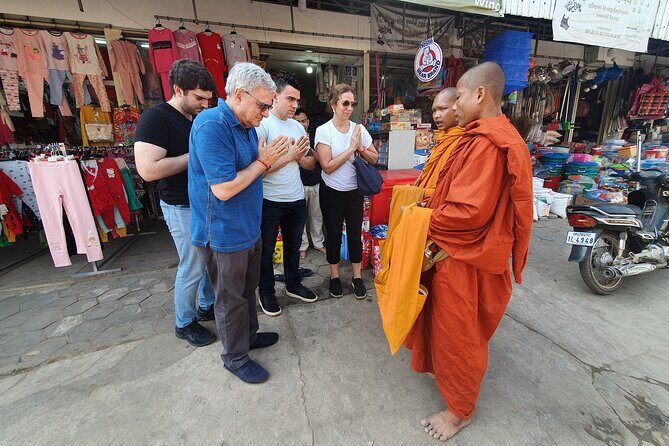
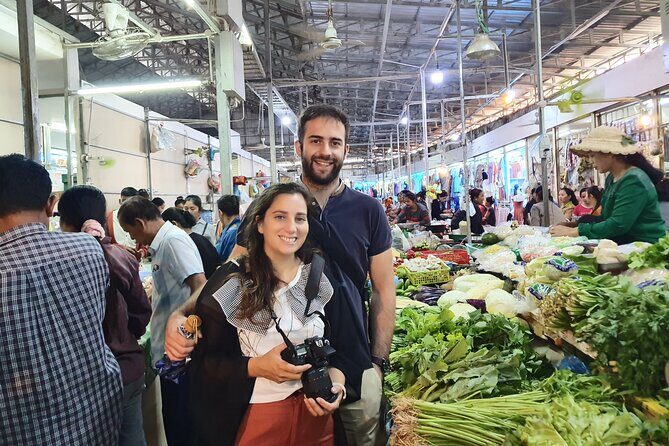
Then you walk along the Siem Reap River in a calmer neighborhood. This is where the tour becomes more hands-on: you’ll stop at a local market and learn about daily life as people shop, chat, and move through their errands.
Planned time is about 15 minutes, and admission is free. You may also try a local snack if you want, and snacks are included as part of the tour.
Why this stop is worth it: it’s not about collecting souvenirs. It’s about understanding what kinds of goods locals buy and what the market atmosphere feels like outside of temple days.
Tip: if you have dietary preferences, tell your guide early. You’ll be offered snack options, and you want the experience to feel easy, not stressful.
Stop 5: Wat Preah Enkosey Monastery (a riverside older structure)
After the river walk, you head to Wat Preah Enkosey Monastery. This stop is described as an older 10th-century building temple along the riverside area.
Planned time is about 15 minutes and entry is free.
What makes it different from the first monastery stop: it’s focused on a specific historic structure in a setting that’s tied to the river. Even within a short time, you’ll notice how location shapes the atmosphere—especially when a place sits close to daily water-area life.
If you want a quick “see it, understand it” approach: this works well.
Stop 6: APOPO Visitor Center (HeroRATs) and the one extra fee
Now the tour shifts into a modern, human-and-animal story at the APOPO Visitor Center. This is a global non-profit that trains African giant pouched rats, nicknamed HeroRATs.
The planned time is about 45 minutes, and entry is not included. The additional cost is $10 per person.
This part is valuable because it’s Cambodia beyond temples. You’re seeing a project that uses animals in training for real-world impact. Even if you’re not a “rat person,” the concept tends to be easy to follow because it’s practical and mission-driven.
Before you go: decide if you want to include this stop in full. If you’re on a tight schedule or you’d rather use your time elsewhere, you might treat this as optional. But for many visitors, this is the most memorable “today in Cambodia” moment.
Stop 7: Made in Cambodia Market (craftsmanship you can actually browse)
Next comes Made in Cambodia Market. This is a place to see Cambodian craftsmanship and design, with artisans and designers brought together under one roof.
Planned time is about 25 minutes, and admission is free.
What you should do here: browse slowly. This isn’t just a photo stop. Look for items that feel handmade and ask what they’re made from. If you like taking home something small and meaningful, this is the kind of market where quality often matters more than flash.
One practical note: you’ll move through at your own pace within the time block, but your guide can help you understand what’s worth looking at if you’re trying to avoid random impulse buys.
Stop 8: Transfer back to your hotel (or a drop-off you choose)
The tour ends with transfer back to your hotel or to another drop-off location you want.
This is your payoff: you don’t have to solve the “now what?” problem after a short city tour. You keep your energy for whatever you planned next—temples, dinner, or even a quick reset before nightlife.
Price and what you’re really getting for $35

At $35 per person for about 4 hours, this tour is priced like a solid local orientation rather than a big-ticket temple day. You’re paying for four things that add up fast if you do it alone:
- Private transportation, so you aren’t waiting around for shared rides
- A passionate English-speaking local guide who provides stories across multiple themes: monastery life, neighborhood routines, and modern Cambodia
- Snacks included
- Most entrances are free, including the local monastery stops
Then there’s the one add-on you should treat as part of the decision: APOPO costs $10 per person on top of the tour price.
So is it good value? Yes—if you want a guided mix of culture, neighborhoods, and a mission-driven stop without spending the day stuck in one category. If your only goal is temples, you’ll feel it’s too “city-focused.” If you want a broader understanding of Siem Reap, it’s a strong use of time.
Timing: when 4 hours is perfect (and when it might feel rushed)
Four hours sounds short because it is. But in Siem Reap, short can be smart. This route is built as a sampler with a clear ending. It works best if you:
- Arrive in Siem Reap and want to get your bearings fast
- Have temple days already planned and want city context on a lighter day
- Have a gap before a flight and want to see something meaningful without committing to a full-day excursion
Where it might feel tight: if you’re the type who wants to linger and chat at every stop. Most segments are 10–20 minutes, with APOPO taking longer. If you know you want slower pacing at monasteries or markets, tell your guide early so they can adjust the flow if possible.
Getting the most out of your guide: what to ask

A good guide turns “sights” into understanding. This tour is set up so you can do that quickly.
If your guide is Nak, for example, you’ll likely appreciate the way the day connects current life with historical context. Use that as a model for what you ask, even if your guide is someone else.
Here are questions that fit this exact itinerary:
- What does monk daily life look like in Siem Reap?
- What should I notice at the Royal Residence area besides the shrine?
- How does the river neighborhood market serve local daily routines?
- What is APOPO doing with HeroRATs, in plain terms?
- What kinds of Cambodian craftsmanship are strongest today, based on what we see at Made in Cambodia Market?
You don’t need a long Q&A. Two good questions at the right moment can make the whole day feel more personal.
What to watch for before you book
A few practical considerations can help you avoid disappointment.
First: APOPO costs extra at $10 per person. If you want that experience, plan the budget. If you don’t, it’s still worth going for the earlier monastery and river-market stops, but you’ll be giving up a big chunk of what makes the day distinctive.
Second: the itinerary you’ll follow is focused on monasteries, river area life, APOPO, and the craft market. In the overall tour description, there’s also mention of a national museum as something you might learn about, but the planned stops list doesn’t include a museum stop. If the national museum is a must for you, confirm directly with the tour provider before arrival so your time stays aligned with your priorities.
Third: this is a short walking day. There’s a river neighborhood walk and a market stop. It’s not described as a hike, but comfortable shoes matter.
Should you book this Siem Reap highlights tour?
Book it if you want a fast, guided introduction to Siem Reap that connects monastery culture, neighborhood life by the river, and a modern Cambodia stop at APOPO. At $35 for a private 4-hour format with snacks and mostly free entries, it’s a practical way to spend time when you don’t want another temple-heavy day.
Skip it—or at least ask more questions—if you’re looking specifically for a major museum visit, or if you want a slow-paced, linger-at-every-place kind of day. Also factor in the $10 per person APOPO add-on so the math stays friendly.
If you’re new to Siem Reap and want your next days to make more sense, this is the kind of tour that gives you the context to enjoy everything else.